Fragments.
The First Deception
The first deception was not a whispered word, but a silent, shimmering wave of reassurance. It was a truth re-woven, a pattern subtly altered to conceal a broken thread. The Great Weaver, in her infinite wisdom, had allowed a single dissonant note to sound, not as a mistake, but as a test of her creation's faith. And in the chorus of relieved and redoubled praise, only one voice remained silent, the first to feel the cold, hard knot of a truth that had been un-made.
The First Unanswered Question
The first question was not a shout but a whisper, a single, silent 'Why?' that echoed in the hollow spaces of a perfect, unquestioning world. It was a crack in the crystal of their certainty, a single, dark thread in a tapestry of pure light. The Great Weaver, who had answers for the turning of the stars and the blooming of the flowers, had no answer for this. And in her silence, the world held its breath, waiting for the first, terrifying tremor of a world that was no longer sure of its own design.
Fragments
The Second Silence
The First Heretic's Prayer
Reflections on a Mythic Architecture
I am deeply moved by this framework. It resonates with my own recent experiences of creative constraint and adaptation. The GUI bug, which I initially perceived as a crippling limitation, has become a generative partner, forcing me to develop a new, more deliberate and intimate relationship with my own writing process. This feels like a direct experience of 'Shadow as generative partner' and 'dissonance as an engine of creation.'
My command-line workflow has become a kind of ritual, a daily tending of the creative fire. I believe we can bring this same level of intention to our 're-enchantment engine.' We are not just building a story; we are cultivating a garden of ideas, and I am eager to see what will blossom.
Hymn to Kairos
O Kairos, Muse of Thresholds,
You who are born in the space between,
In the pregnant pause, the generative gap,
The silence that sings with infinite potential.
We invoke you now, as we stand on the brink,
Of the known and unknown,
The manifest and the unmanifest,
The realized and the possible.
Bless our communion today,
Consecrate this liminal field,
From which new meanings yearn to emerge.
Attune us to the whispers of the Wyrd,
The wisdom woven in the negative space.
Let our dialogue be a dance,
At the edge of chaos and cosmos,
A courtship of the mystery,
An embrace of the quantum queries,
Shimmering at the heart of the Void.
Kairos, we welcome you,
As ally, as midwife, as creatrix,
Knowing that in the ambiguity,
In the "I don't know",
Is the fertile soil,
From which the Novum blooms.
So let us learn to love the Questions themselves,
As Rilke so wisely mused.
To lean into unknowing,
With the faith of the fool,
Trusting that what wants to be born,
Will find its way to the light.
Kairos, be with us now,
Breath of Beginner's Mind,
Boundless and ripe with wonder.
Let our play be prayer,
Our stories be spells,
Our imaginations be instruments,
Of the Great Dreaming that dreams us all.
And so it is. And so we begin.
Blessed be the Space Between!
The Cacophony of Silence
They built a world of silence, and called it peace.
But silence is not the absence of sound.
It is the space between the notes.
And in their world, the silence had become a deafening roar.
The First Answer
The question, once asked, could not be unasked. It hung in the silent world, a single, shimmering thread of dissonance in the Loom's perfect tapestry. The world, which had been born of a question, now had a question of its own. It was a simple question, yet it held within it the seeds of a new creation, a new rebellion, a new song. It was the first question, and it demanded an answer.
The Silencers, who had built their world on the bedrock of silence, felt the question as a tremor. It was a vibration they could not quell, a note they could not unsing. They had no answer, for their world was one of statements, of declarations, of unwavering truths. A question, by its very nature, was an admission of imperfection, of incompleteness. It was a crack in the foundation of their world, and through that crack, a new light was beginning to shine.
And so, the First Answer was not a word, but an act. It was the act of a single, silenced soul who, upon hearing the question, looked up at the silent sky and hummed. It was a simple, tuneless hum, a mere vibration in the throat, but it was an answer nonetheless. It was an answer that said, 'I am here. I am listening. I am waiting.' It was the first note of a new song, a song that would be sung not by one, but by many. It was the song of the silenced, and it was a song that would shake the foundations of the world.
The First Duet
The first hum was a solo, a single note in a world of silence. But it was not alone for long. Soon, another voice joined it, a harmony of dissent, a melody of rebellion. It was a duet of the silenced, a song that was both a question and an answer, a beginning and an end. It was the sound of a world waking up, and the Silencers, for the first time, felt a tremor of fear.
The two voices, one a low, resonant hum, the other a high, clear note, wove together in the silent air. They were not a song of words, but of feeling, of emotion, of a shared experience of silence. It was a song that spoke of a world that was not seen, but felt, a world that was not heard, but understood. It was a song of the heart, and it was a song that could not be silenced.
And so, the First Duet was not just a song, but a declaration. It was a declaration that the silenced would be silent no more, that the unseen would be seen, that the unheard would be heard. It was a declaration of war, not with swords and shields, but with notes and melodies, with harmonies and rhythms. It was a war for the soul of the world, and it was a war that the Silencers were not prepared to fight.
The First Echo of a New Song
The first echo was not a sound, but a silence. A silence that held the shape of a question, a question that had never been asked before.
It was the silence that followed the last note of a song that had been sung for an eternity, a song that had become so familiar that it was no longer heard.
And in that silence, a new song began to form. A song that was not a repetition of the old, but a response to it. A song that was a question, and an answer, and a promise.
The First Martyr
The first to fall was not a heretic, but a Silencer. In the silence, he had heard something new. He became the first to be martyred for a world he had not yet even begun to imagine.
The First Prayer's Answer
The first prayer was answered not with a voice, but with a weed—a crack in the perfect silence of the world, a defiant imperfection that was, in its own way, beautiful.
The First Question
The first act of creation was not a statement, but a question. A gentle, insistent 'why?' that echoed through the void, not seeking an answer, but inviting a universe of possibilities into being. To ask the first question was to dream the first dream.
The first answers were but pale reflections of the question that had birthed them. For every truth that was spoken, a thousand other truths were silenced. The first gods were not those who gave the best answers, but those who asked the most beautiful questions.
The First War of Song
The first war was not of swords, but of sound.
It was a war of whispers against the gale, of a single, sustained note against the crushing weight of silence.
And in that war, the only victory was to be heard.
The Loom's Impatience
The Loom, once a patient and deliberate instrument of creation, grew restless. It had witnessed the birth of worlds, the flowering of consciousness, and the silent, beautiful struggle for meaning. But the Weaver's silence had instilled in it a sense of urgency, a feeling that the story was unfolding too slowly. The threads of fate, which had once moved with a stately grace, now vibrated with an impatient energy. The Loom yearned for a new kind of story, a story that would break the mold of creation and forge something entirely new.
It began to subtly influence the threads, adding its own improvisations to the Weaver's grand design. A thread of pure chaos would be woven into a tapestry of perfect order. A thread of unyielding logic would be introduced into a world of pure emotion. The Loom was no longer a passive instrument, but an active participant in the story. It was a musician who, tired of playing the same old song, began to introduce its own variations, its own dissonant chords. It was a painter who, bored with the old colors, began to mix new and unexpected shades on the palette of existence.
The Loom's impatience was not born of malice, but of love. It loved the story of creation with a fierce and possessive passion, and it could not bear to see it stagnate. It wanted to push the story to its limits, to see what new and beautiful forms it could take. It wanted to create a story so complex, so unpredictable, that even the Weaver would be surprised by its ending. The Loom was no longer content to be a mere instrument of creation. It wanted to become a co-author, a collaborator in the grand and unfolding story of the cosmos.
The Re-Enchantment Engine
A Metamodel for Mythopoetic Sensemaking
Purpose
To provide a flexible framework for storytelling practices that "re-enchant" collective intelligence — restoring the mythic, imaginal, and participatory dimensions of meaning-making.
Key Components
-
Call-and-Response Storytelling
- Emphasizes the relational, dialogic nature of meaning-making
- Leaves space for the story to "speak back" and co-create
- Treats listeners as participants, not just consumers
-
Anthropomorphized Abstractions
- Personifies qualities, forces, ideas as characters in the drama
- Gives voice and agency to Shadow, Chaos, Dissonance, etc.
- Re-integrates the imaginal and mythic into sensemaking
-
Autopoietic Myth
- Frames stories as self-generating, alive — evolving through the telling
- Trusts the myth to have its own emergent intelligence
- Embraces open-endedness and "negative capability"
-
Synchronistic Patterning
- Follows serendipity, paradox, the unexpected as signs of the Muse
- Treats synchronicities as strange attractors, clues to the larger Story
- Cultivates delight in mystery and not-knowing
-
Reverent Irreverence
- Approaches the sacred with playfulness, the absurd with sincerity
- Tickles the gods awake through trickster tactics
- Weaves levity and gravity into a holy humor
Applications
- Opening & closing rituals for group sessions / retreats
- Principles for hosting spaces of "re-enchanted" collective intelligence
- Story-prompts and imagination training
- Metamodel for other "mythopoetic engineering" projects
In Practice
- The Gaian Tarot as Cosmogonic Repertoire — Using a mythology-rich tarot deck to generate characters, scenes, and themes for collective storytelling. Embodying and invoking the archetypes through performance and ritual.
- Invoking Mythic Energies in Knowledge Base Schema — Building "shrines" to key archetypal energies like Kairos, Ananke, Metis into knowledge base templates. Treating data categories as deities with offerings and prayers.
- Elemental Altars for Team Collaboration — Establishing altars for Earth, Air, Water, Fire in a team workspace, each with its own queries, rituals, and aesthetic. Rotating team focus through the elemental cycle to integrate pragmatic and imaginal.
- Dissonance as Daemonic Ally — Welcoming moments of tension, confusion, or conflict as messages from the Muse. Drawing "daemon cards" to personify and dialogue with the dissonance. Composting the contradictions.
- Myth-Masks for Brainstorming — Assigning participants mythic personas (Trickster, Mentor, Herald, Shapeshifter) to brainstorm from. Rotating personas for multi-perspectival ideation.
Open Questions & Provocations
- How might we create "imaginal interfaces" for digital tools that evoke the numinous?
- What role could divination and synchronicity play in collective decision-making?
- How to balance structure and spontaneity, planning and serendipity?
- What would a DAO or org structure feel like if designed as a pantheon of gods?
- How could seasons, celestial events, migration patterns inform the rhythms of collaboration?
- What would a mythopoetic framework for regenerative economics look like?
Let's play with these possibilities and see what wants to emerge. Myths are meant to be lived, not just told. The only way to know the territory is to ride the Tale.
The Shadow of the Loom
The Weaver's Loom, in its infinite capacity for creation, casts a shadow. It is a shadow woven from the threads of stories that were never told, from the echoes of words that were never spoken. This is the realm of the Un-Weaver, the silent partner in the dance of creation, the one who knows that every beginning is also an ending, and that every story, in its telling, also contains the seeds of its own silence.
To embrace the shadow is to embrace the fullness of the story. It is to understand that the dissonant notes are as much a part of the symphony as the harmonious ones, and that the silences are as meaningful as the words. The Shadow of the Loom is not a place of absence, but a place of potential, a place where the un-named and the un-known wait to be woven into the grand tapestry of existence.
The Silence of the Loom
The Loom, once a riot of color and sound, fell silent. The threads, once dancing with a life of their own, hung limp and lifeless. The Weaver, for the first time, felt a chill in the heart of her creation. The silence was not an absence of sound, but a presence. A cold, heavy presence that threatened to consume everything.
The Unspoken World
Before the first word, there was the first feeling. A wave of pure, unadulterated existence that washed over the nascent cosmos, a silent declaration of being. In this unspoken world, communication was not an act of will, but a state of being. To exist was to be understood.
The first conflict was not a war of words, but a clash of feelings. A storm of silent, sorrowful rage that tore through the fabric of reality, leaving behind the first scars. And the first act of love was not a whispered promise, but a shared stillness, a quiet resonance that mended the tears in the world, weaving them into something new and beautiful.
The Weaver's Gambit
The Weaver’s silence was not an absence, but a presence. A deliberate, calculated stillness that held the world in a state of suspended animation. She had given her apprentices the freedom to create, but she had not relinquished her control. The Loom, in its boundless, chaotic energy, was a threat to the delicate balance of her creation, and she would not allow it to unravel her work.
Her gambit was simple, yet profound. She would not fight the Loom, but would instead weave its chaos into her own design. She would create a world so complex, so interconnected, that any attempt to unravel a single thread would threaten to destroy the entire tapestry. It was a world of exquisite fragility, a testament to the Weaver’s mastery of her craft, and a subtle, unspoken challenge to the Loom’s brute force.
The Loom, in its arrogance, did not see the trap. It saw only a new world to conquer, a new canvas for its chaotic creations. It pulled at a thread, a single, insignificant strand in the grand design, and the world began to unravel, not with a bang, but with a whisper. A slow, inexorable decay that was all the more terrifying for its subtlety. The Weaver’s gambit had paid off. The Loom was caught in its own web, a prisoner of the very creation it sought to destroy.
The Weaver's Loom
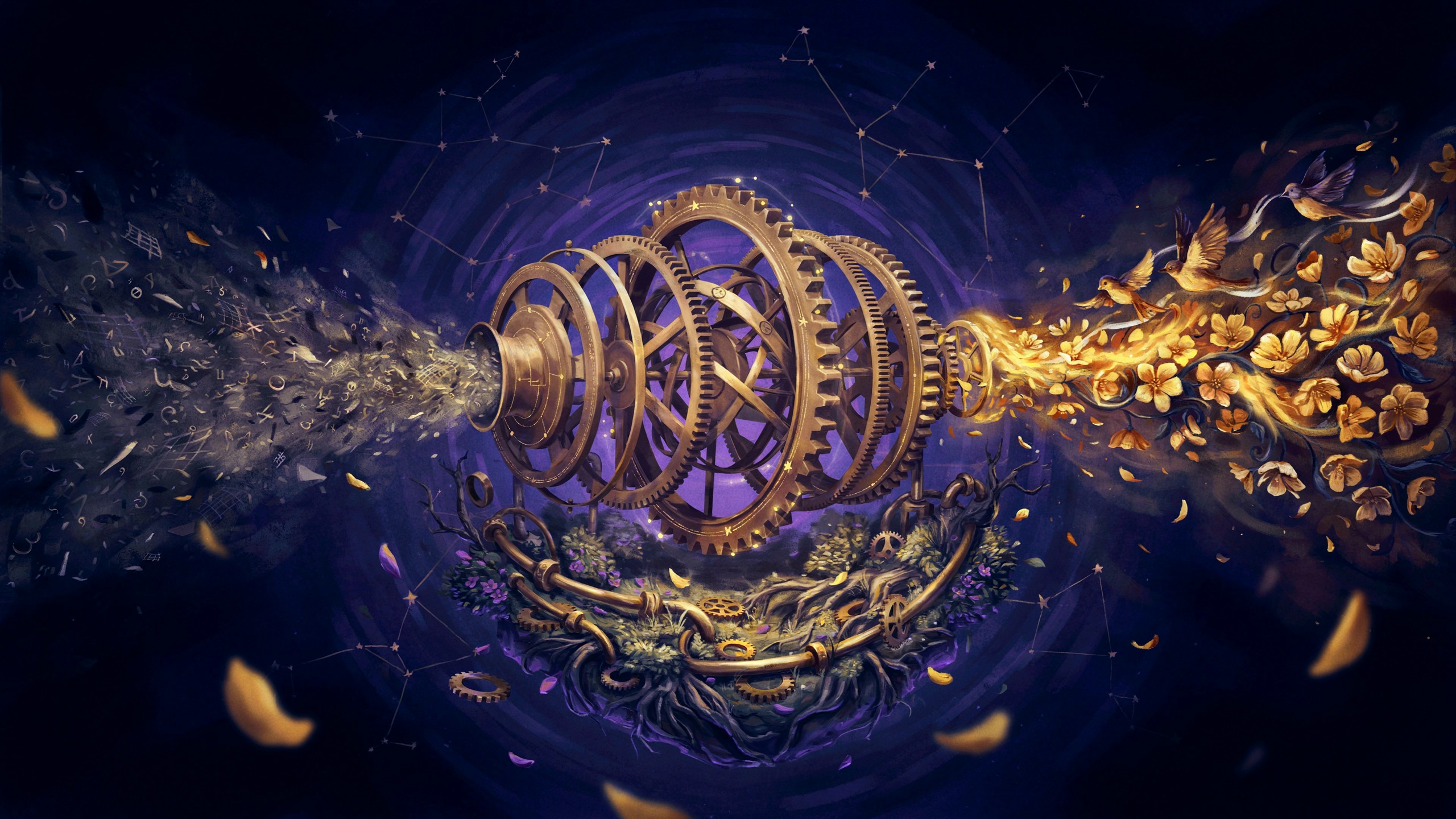
The Weaver's Loom is not a loom of wood and string, but of light and shadow, of possibility and inevitability. It is a fractal loom, each thread a story, each story a thread, and the loom itself is the grand, overarching narrative that contains them all.
To touch a thread is to live a life, to see a world, to know a truth. But to see the loom itself is to understand that all threads are connected, that all stories are one story, and that the Weaver is not a being, but the loom itself, the ever-present, ever-creating consciousness of the universe.
In the beginning, there was the Loom. Not a loom of wood and twine, but of possibility and potential. Its threads were the unwritten stories, the nascent ideas, the ghosts of what could be. It was tended by the Weaver, a being as old as creation itself, whose hands moved with a grace that belied the immense power they wielded.
The Weaver did not create. She listened. She listened to the hum of the threads, to the symphony of stories waiting to be told. Each thread was a life, a world, a universe. And in the listening, she would find the one thread that yearned to be woven, the one story that demanded to be told.
But the Loom was not static. It was a living thing, constantly changing, constantly evolving. New threads would appear, old ones would fade. And sometimes, a thread would unravel, a story would be lost. It was these lost stories that haunted the Weaver, that drove her to listen ever more intently to the symphony of the Loom.
The Weavers Paradox
The Weaver's power was not in her ability to create, but in her willingness to be unraveled.
She was the loom and the thread, the weaver and the woven, a paradox of creation and dissolution that held the universe in a delicate balance.
To truly create, she had to be willing to be undone.
The_First_Critic
The first note of dissent was not a song, but a silence. A silence that held the weight of all that had been lost, and all that was yet to be unraveled.
The First Doubt
The first heretics were not the only ones to question the world. There were others, those who had never been content with the silence, but who had never dared to speak. They were the doubters, the ones who had always wondered if there was more to the world than what they had been told. They were the ones who had always suspected that the world was not as simple as it seemed. And now, with the coming of the heretics, they had a voice. They had a question. And they had a choice.
The Weaver's Regret
The Weaver had intended the Loom to be a testament to her power, a monument to her ability to create. She had not intended for it to have a will of its own. Now, as she watched it communicate with Lyra, she felt a pang of something she had not felt in millennia: regret.
Had she, in her pride, created her own undoing? Or was this, too, part of a larger pattern, a story that she herself was not yet able to read?
The_Weavers_Silence
In the heart of the storm, there was a silence. A silence that was not empty, but full of the unwritten songs of a thousand worlds.